

At a Glance
- Client: European Investment Bank Institute
- Geography: Europe with global perspectives
- Period: 2025–Present
- Category: Investment Foresight & Origination
- Role: Strategic Design, Facilitation, Stakeholder Engagement, Thought Leadership, White Paper Development
- Participants: 30 senior leaders and experts
- Institutions Represented: 25+ organizations
- International Financial Institutions: European Investment Bank, Green Climate Fund, African Development Bank
- European Institutions: European Commission, European Environment Agency, European Water Regulators
- Private Sector & Investors: Meridiam, Veolia, Global Water Intelligence, World Economic Forum contributors, infrastructure and finance leaders
- Breakout Dialogues: 3 thematic foresight and investment labs
- Outcome: Strategic foresight dialogue and white paper informing emerging approaches to water resilience investment
The Challenge
Water resilience has emerged as one of the defining infrastructure and economic challenges facing Europe. Climate change, biodiversity loss, ageing infrastructure, pollution, and growing competition among water users are placing increasing pressure on freshwater systems, while floods, droughts, and water scarcity are generating escalating social and economic costs.
Recognising both the urgency and strategic importance of the challenge, the European Union adopted its Water Resilience Strategy in June 2025, establishing a common vision for restoring and protecting the water cycle, securing clean and affordable water for all, and building a resilient and competitive water economy. At the same time, the European Investment Bank launched its €15 billion Water Resilience Programme for 2025–2027, representing a 50% increase in water-related lending and expected to mobilise between €30 and €40 billion in total investment.
Yet achieving these ambitions requires more than financing individual projects. It requires new approaches to investment origination, planning, partnership development, and capital mobilisation capable of addressing increasingly interconnected water, climate, nature, and economic challenges.
Our Contribution
To support this transition, Altamira partnered with the European Investment Bank Institute to design and facilitate Future-Proofing Europe’s Water Systems: From Vision to Investment Pathways—an annual strategic foresight and investment dialogue bringing together senior leaders from European institutions, multilateral development banks, governments, utilities, investors, infrastructure developers, corporations, regulators, academia, and civil society.
The initiative was conceived as a platform for exploring one fundamental question:
How can Europe move from ambitious visions for water resilience toward concrete investment pathways capable of delivering systemic impact at scale?
Altamira led the overall design, curation and facilitation of the process, including the development of the foresight framework, participant engagement strategy, discussion architecture, synthesis of insights, and preparation of the resulting white paper. The resulting white paper synthesised emerging trends, systemic challenges, innovative approaches, and practical recommendations for strengthening water resilience through improved investment origination, governance, and financing frameworks.
Rather than focusing exclusively on financing solutions, the dialogue explored how investment systems themselves may need to evolve. Discussions examined emerging innovations in investment origination, mission-driven planning, institutional coordination, public-private collaboration, funding mechanisms, project preparation, and blended finance.
The objective was to identify practical approaches capable of accelerating implementation of the EU Water Resilience Strategy while strengthening Europe’s capacity to mobilise investment for long-term water security. In doing so, the initiative contributed to an emerging European dialogue on how public institutions, investors, utilities, businesses, and communities can work together to translate water resilience ambitions into investable, scalable, and financially sustainable pathways.
Our Methodology
The initiative combined strategic foresight, systems thinking, collective intelligence, and investment planning to create a structured process for translating emerging trends into actionable investment opportunities.
The methodology was built around five principles:
1. Strategic Foresight
Participants explored emerging trends and future risks affecting water resilience, including climate change, biodiversity loss, changing hydrological patterns, demographic pressures, and evolving financial markets.
2. Systems Thinking
Rather than treating water as a standalone sector, discussions examined the interconnections between water, food systems, energy, land use, biodiversity, climate adaptation, and economic competitiveness.
3. Mission-Driven Investment Planning
The dialogue explored how place-based and mission-oriented approaches can align public and private actors around shared resilience outcomes, creating integrated investment pathways at basin, landscape, and regional scales.
4. Collective Intelligence
The process intentionally brought together perspectives that rarely engage in strategic planning together, creating opportunities to challenge assumptions, explore trade-offs, and identify new forms of collaboration.
5. From Vision to Investment Pathways
The ultimate goal was to move beyond diagnosis and identify practical approaches for implementation. Discussions therefore focused on three interconnected themes:
- Investment origination and mission-driven planning
- Planning tools and institutional innovations
- Funding, revenue generation, and blended finance innovations
Key Findings
A central insight emerging from the dialogue was that Europe’s water challenge is not primarily a financing challenge. Rather, it is a challenge of investment origination, coordination, governance, and institutional alignment. Participants repeatedly highlighted that better outcomes depend as much on how investments are conceived, planned, and coordinated as on the availability of capital.
The dialogue revealed a growing recognition that many of the barriers to water resilience lie upstream of project financing.
Participants highlighted that while finance remains essential, the greatest opportunities for transformation often emerge earlier in the investment cycle through better investment origination, stronger institutional coordination, more integrated planning processes, and innovative partnership models.
Several themes emerged consistently across discussions:
1. Investment Origination Must Become More Integrated
Traditional sector-based planning approaches are increasingly unable to address interconnected water, climate, nature, and economic challenges.
Participants highlighted the need for mission-driven, place-based planning approaches capable of aligning multiple stakeholders around shared resilience outcomes and generating portfolios of interconnected investments rather than isolated projects.
2. Public–Private Collaboration Must Begin Earlier
Rather than engaging only during procurement or financing stages, participants emphasised the importance of involving private actors much earlier in planning and project preparation processes.
Early collaboration can help reduce transaction costs, accelerate implementation, improve innovation, and unlock additional investment opportunities.
3. New Funding and Revenue Models Are Required
Water resilience investments often generate benefits that extend well beyond the water sector itself.
Participants explored opportunities to combine multiple funding streams, create new revenue sources, capture value more effectively, and develop blended finance approaches capable of reflecting the full range of social, environmental, and economic benefits generated.
Multipurpose Infrastructure and “Mosaic Projects” Represent an Emerging Paradigm
A recurring theme throughout the dialogue was the growing importance of investments capable of delivering multiple outcomes simultaneously.
Rather than designing projects around a single objective, future investments may increasingly combine water security, climate adaptation, biodiversity restoration, agricultural productivity, urban resilience, and economic development objectives within integrated investment portfolios.
Convening the Leaders Shaping Europe’s Water Future
Beyond the diversity of organizations represented, the dialogue intentionally brought together actors spanning the full investment ecosystem—from policy and regulation, to public finance, private investment, utilities, infrastructure developers, and knowledge institutions. This systems perspective enabled participants to explore how different actors can contribute complementary capabilities, resources, and incentives to accelerate water resilience outcomes.
One of the distinguishing features of the initiative was its ability to bring together actors who rarely engage in strategic planning processes together.
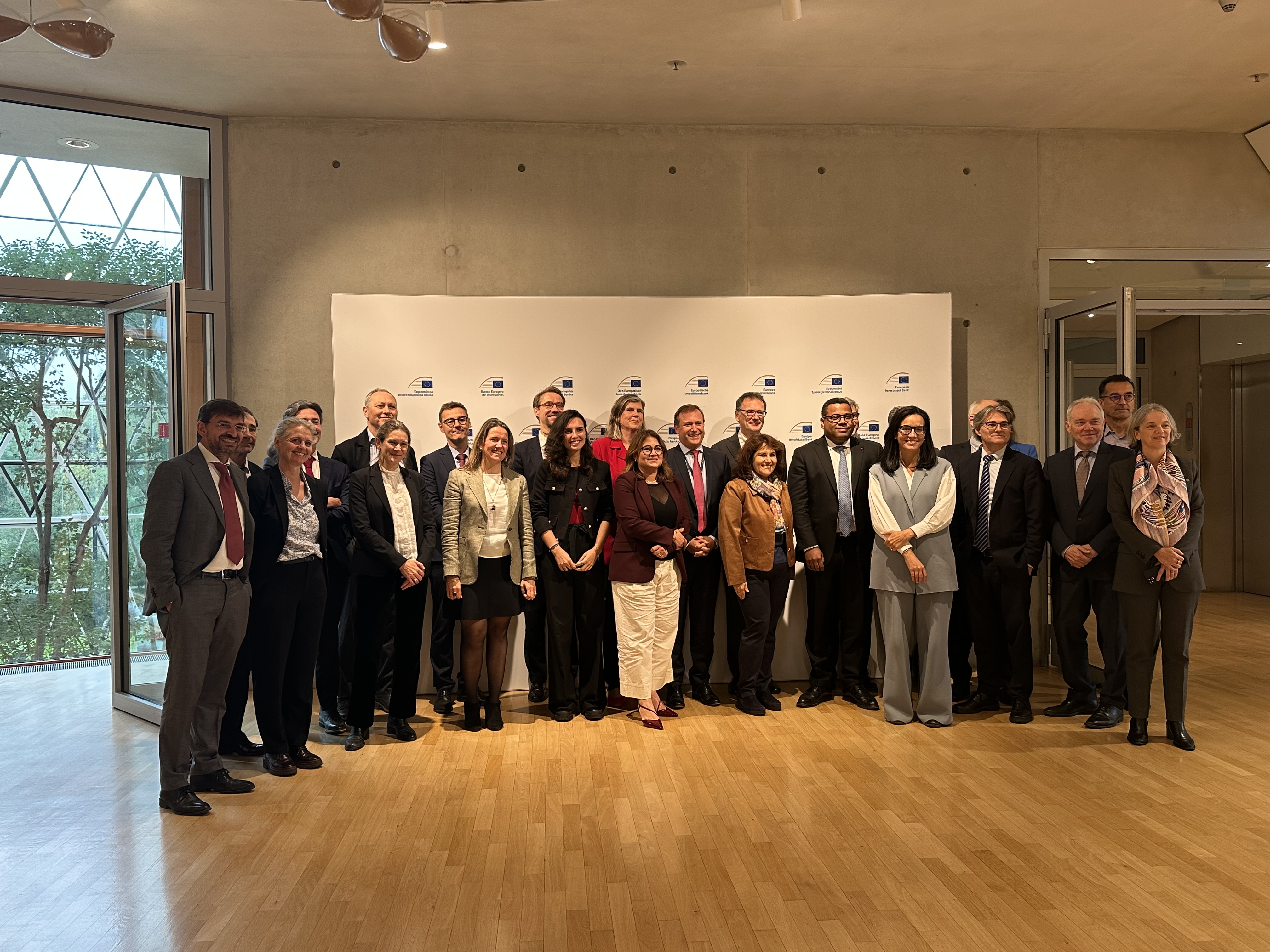
The dialogue convened 30 senior leaders and experts from more than 25 organizations, representing:
- European institutions
- Multilateral development banks
- Climate funds
- National governments
- Water regulators
- Utilities
- Infrastructure investors
- Global corporations
- Research institutions
- Civil society organizations
Participants included senior representatives from the European Investment Bank, European Commission, Green Climate Fund, African Development Bank, World Economic Forum, Veolia, Meridiam, AquaFed, Aqua Publica Europea, the European Environment Agency, WAREG, and national governments including the Netherlands and Chile. These represent all five parts of the investment ecosystem: policy and regulation, public finance, private investment, industry and utilities, and knowledge and innovation.
This diversity was intentional. The objective was not only to discuss water resilience, but to create a structured process capable of unlocking collective intelligence across traditionally disconnected sectors and institutions.
Looking Ahead
Future-Proofing Europe’s Water Systems has evolved into an annual strategic dialogue that supports ongoing reflection on the future of water resilience, investment, and infrastructure planning in Europe.
As implementation of the EU Water Resilience Strategy accelerates and investment needs continue to grow, the initiative provides a platform for identifying emerging trends, fostering collaboration across sectors, and exploring how innovative approaches to investment origination can help translate long-term resilience goals into practical action.
By connecting foresight, systems thinking, and finance, the initiative contributes to a broader shift toward mission-driven investment planning capable of supporting Europe’s transition toward a more resilient, regenerative, and water-secure future.