A Milestone for Europe’s Water Future: Reflections from the First EU Water Resilience Forum


The launch of the first EU Water Resilience Forum on December 8 marked a milestone moment — not only for Europe but for all regions grappling with the escalating impacts of climate change. As EU Commissioner for Environment, Water Resilience and Competitive Circular Economy, Jessika Roswall highlighted in the opening session, Europe is facing a water reality defined by floods, droughts, declining reservoirs, and growing pollution pressures. These risks are no longer abstract: they are material, economic, social, and ecological.
What resonated strongly throughout the Forum is how closely this aligns with what we are observing in our work across Latin America and the Caribbean with United Nations Economic Commission for Latin America and the Caribbean (ECLAC): how we plan and finance water investments matters just as much as how much we invest. Buildingresilience requires system transformation — in governance, in financial architecture, and in the way we understand the functions water systems perform and the mechanisms we design to capture and monetise the value they create. This was also the central conclusion of our special session during the first Regional Water Week: Closing the Implementation and Financing Gap for Water Security in LAC.
Putting the Water Cycle at the Center of our investment planning systems
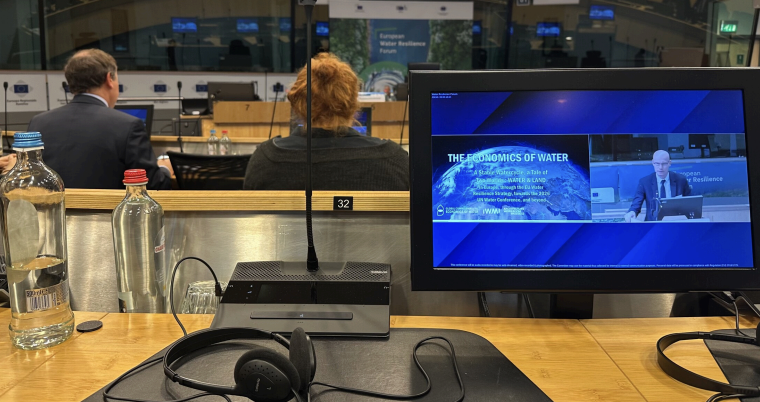
During the plenary, Henk Ovink (Global Commission on the Economics of Water) reminded us that the resilience challenge begins with the broken water cycle itself. Europe’s commitment to restoring that cycle —through sponge landscapes, source protection, and integrated basin management — is a powerful signal that resilience cannot be delivered through incremental fixes. It requires rebuilding natural infrastructure alongside engineered systems, and valuing water for the multiple services it provides: public health, ecosystem regeneration, economic competitiveness, and climate security.
This systems framing is exactly what the Financing Framework for Water Security underscores: mapping the functions of water systems —and the specific water security investments associated with them — is essential for identifying viable revenue strategies, strengthening cost–benefit analysis, and ensuring fair risk allocation between public and private actors. A crucial first step is understanding the economic nature of the goods and services being delivered by both natural and builtinfrastructure: whether they are private, club, public, or common-pool goods. This classification shapes the options for fit-for-purpose governance arrangements and revenue models. For instance, public goods are typically financed through taxes or transfers and deliveredthrough public procurement mechanisms — ranging from traditional design–bid–build contracts to more complex public–private partnership structures.
Financing Water Resilience: Rethinking Roles and Redesigning the Plumbing
The session on Financing the Way to Water Resilience, expertly moderated by Magdalena Rzeczkowska (European Economic and Social Committee), brought these issues into sharp focus. Speakers such as Edouard Perard, PhD (European Investment Bank (EIB)), Ben Townsend (Google ), Tim Segboer (Nederlandse Waterschapsbank (NWB Bank)), and Job van Schelven (PureTerra Ventures) illustrated the breadth of actors who now shape the financial architecture of water resilience.
Several insights stood out:
- Major industry players are integrating water into capital investment decisions — including the siting of data centres and water–energy optimisation that can reduce energy use by up to 40%.
- European financial institutions are leveraging sustainability-linked bonds, where achieving water-related KPIs reduces borrowing costs, aligning incentives while strengthening governance.
- Venture capital voices emphasised the need to “fund the future, fund failure, and funnel funding,” recognising that innovation requires tolerance for risk — yet innovators still struggle to access available capital.
Overall, the two financing challenges highlighted align with what I have observed across regions regarding financing of water security and adaptation: funding not financing per se is where the main challenge exits, and then the money exists, but the plumbing — the mechanisms, intermediaries, and enabling environment to move it — still needs redesign to reach utilities, communities, SMEs, and watershed actors.
Industry, Regions, Rural Areas: Broadening the Lens
Sessions across the day reinforced the cross-sectoral nature of the resilience transition. From industry leaders in the parallel session discussing competitiveness and zero pollution, to regional representatives speaking on rural water use and irrigation’s share of Europe’s water footprint, the message was clear: resilience requires both territorial approaches and industrial transformation.
Rural areas must not be an afterthought. Agriculture as pointed out by Ramiro Angulo Sanchez from Junta de Andalucía remains a major water user worldwide, and while overall agricultural water use in the EU has declined, it is still the largest water-consuming sector, particularly in Southern Europe (Spain, Greece, Cyprus). In these regions, irrigation accounts for roughly a quarter to more than 40% of total freshwater abstraction, placing significant pressure on water resources. Strengthening the sector’s sources of funding — the “3Ts” identified by the OECD: tariffs, taxes, and transfers — together with robust water governance at the basin scale is essential to unlock the investments needed for long-term resilience.
Innovation, Skills, and Digital Transformation: Closing the Planning–Implementation Gap
Europe’s agenda goes beyond strategy — it aims to address the persistent bottleneck between planning and delivery. The Commissioner’s announcements highlight this clearly:
- Water Resilience Investment Accelerator
- Digitalisation Action Plan for the Water Sector
- European Water Academy
- Water Resilience Stakeholder Platform
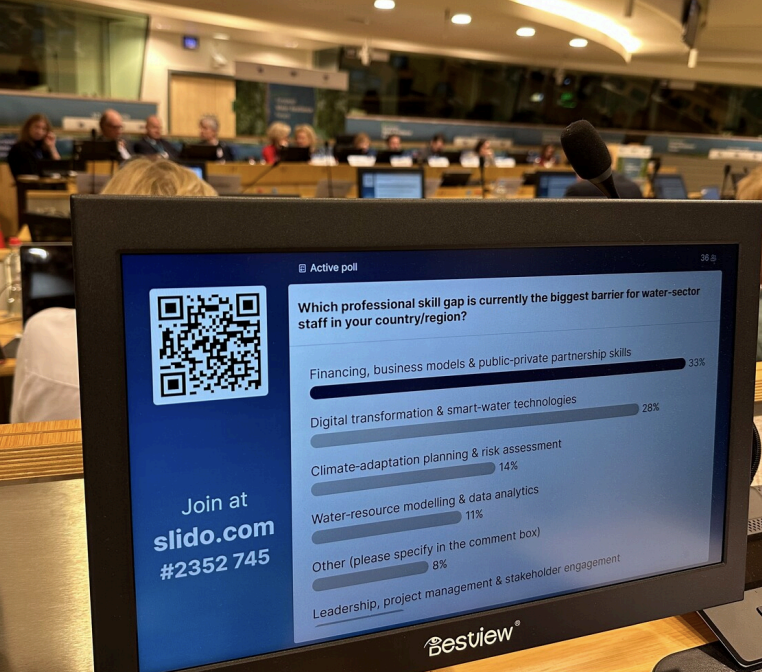
During the session "Upskilling for Water Resilience: Inception for the European Water Academy," representatives from the Joint Research Centre, the World Water Academy, and leading associations presented the results of a survey conducted to inform its design. This survey, along with one conducted in the room, confirmed that skills in project preparation, PPP structuring, and business models are critical. This aligns closely with our work at ECLAC on strengthening capabilities for investment prioritisation and project preparation.
If we want to close the gap between plans and reality — a gap the President for the Committee of the Regions Kata Tüttő described as currently having “nothing to do with each other” — then human capital becomes the decisive factor.
Nature-Based Solutions: Borrowers, Promoters, and Bankability
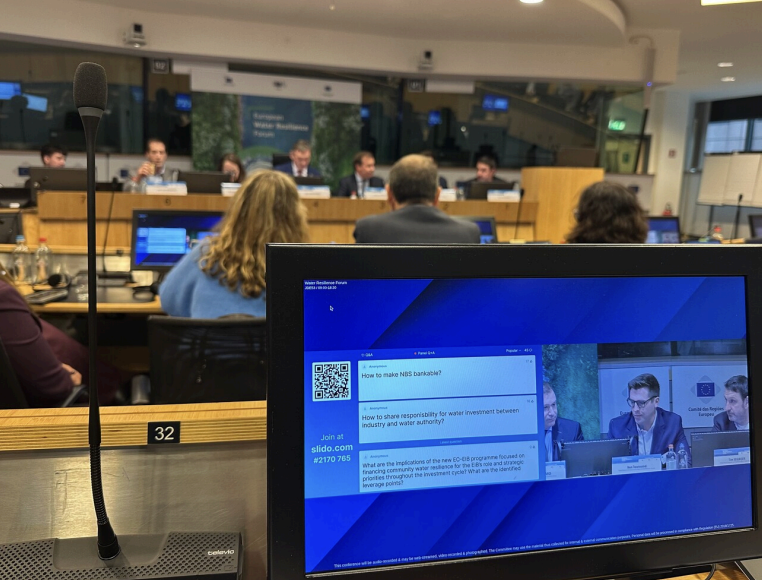
An important conversation emerged around making NBS bankable, and I appreciated the clarity offered by Edouard Pérard and others in the forum: financing NBS is not fundamentally different from financing other public goods, and we should avoid framing them as competing with, or separate from, traditional infrastructure assets. What is essential, however, is the presence of clear borrowers and strong project promoters — and this is where the NBS community must step up.
A deep leverage point lies in strengthening the capacity of local and regional governments to develop a transformational pipeline of investments: beginning with a strategic vision of what a regenerative or nature-positive economy could look like within a specific watershed or landscape, and extending all the way to structuring a pipeline of bankable, investable projects that follow a mission-driven and programmatic approach to investment origination and monitoring. This is precisely the kind of impact we aim to support through the series of local-government bootcamps under NetworkNature EU — an effort we at ALTAMIRA Regenerative Finance are proud to lead.
The critical question ahead:
Who will lead watershed-level investments in protecting water sources — utilities, basin agencies, or new institutions?
Answering this will determine how quickly Europe can mobilise capital for source protection and ecosystem restoration.
Toward a Water-Smart and Regenerative Europe
The Commissioner closed with a compelling reminder: Europe cannot afford to waste a single drop and cannot afford the price of inaction. Yet with coherent planning, smart regulation, digital innovation, and aligned incentives, Europe can move decisively toward a water-smart, regenerative economy.
And with 20 pilot projects set to be financed through the Water Resilience Accelerator in 2026–2027, institutions like the EIB are poised to demonstrate what cross-sectoral, bankable resilience models look like in practice.
For those of us working globally on water security, Europe’s momentum offers a powerful signal:
Restoring the water cycle is not only possible — it is becoming irresistible.
Let ́s turn the tide together as the Global Commission on the Economics of Water calls on all of us to do.