Where I choose to belong: “Ya estamo en la calle sal de tu balcón"


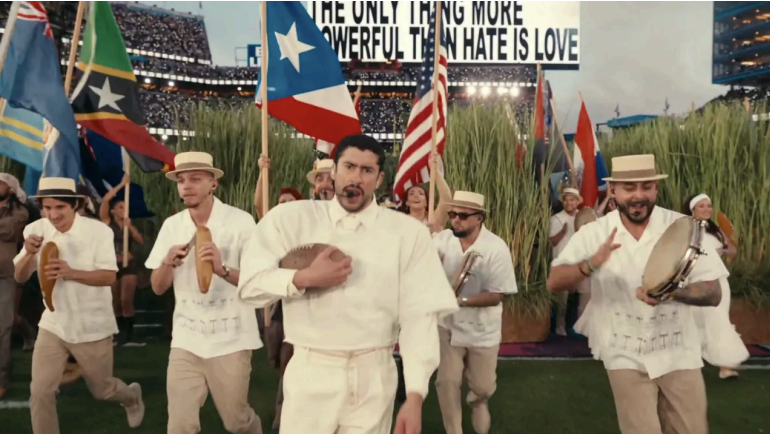
I honestly was not a Bad Bunny (Benito) fan until a few weeks ago. Over the last weeks, I’ve been following his public appearances, and now also everything around the Super Bowl. Alongside that, I read several analyses about him, including one in La Nona Ora by Remi Carlioz with this striking idea of belonging but not being part of.
And then there were his final words in the Super Bowl—God bless America—followed by naming all the countries in the American continent.
That opened something for me.
If someone asked me to describe my own process of self-development over the last years, this might be the clearest way to put it: I found myself, too often, belonging to things without truly being part of them. Constrained by the rules of groups I did not feel I belonged to. Framed as the other—a foreigner, an alien, or, as the Dutch word puts it, a vreemdeling: literally a “stranger,” someone tolerated and proximate, but never fully inside.
You are expected to belong. And yet everything you bring—everything you build, develop, or contribute—is treated as property of the system, not as something you co-own.
I imagine this is close to how Puerto Ricans experience it. And how the law reflects it.
Five years ago, I began choosing—very explicitly—to belong only to the things I am genuinely part of. To create new tables where we all can belong. I’ve been fortunate to find opportunities to do that. And today, if there is one clear criterion for whether I work with a client or join an initiative, it is this: do I feel that I truly belong—and does this work reinforce structures where others can belong as more than tolerated participants?
If not, honestly, no matter how attractive the opportunity is, I’m not interested.
Because politics is not played only where we are told it is. I believe we all play politics and weave the narratives for or against social justice and true inclusion, every single day. We all make choices—daily—about what kind of world we are reinforcing or resisting.
I’m aware that I have a voice, and enough of a network, to stand up for others who have less of both. For those who, as the article puts it, are dismissed as noise.
What struck is how precisely this move can be named: when a system decides your speech is “noise,” it is not disagreeing with you—it is denying that you are speaking at all.
What happened at the Super Bowl didn’t change the laws, yet. Still, it carried enormous symbolic weight. It encouraged people—regardless of culture or minority status—to play politics where they are. To work so that people can belong. And to resist the narratives that trap people in predefined roles and then dismiss their voices as irrelevant or excessive.
Coincidentally, this weekend at home, I had a long conversation with my husband and my son. I felt that my daughter—who is a teenager—and I— who, since my forties, have allowed myself to be angry when it feels justified—were being framed as unreasonable. Not explicitly, but through a familiar language used for women in families and workplaces alike: emotional, reactive, hysterical.
And once again, a simple adjective becomes a web. A single word that carries an entire narrative—one that disqualifies what you say before it is even heard. This is the same mechanism used against women, against foreigners, against anyone marked as “other.”
That is why this moment matters.
And that is also why I loved the way he said God bless America. Because for those who learned geography in the Northern Hemisphere, it is worth being precise: America is one continent, composed of South America, Central America and the Caribbean and North America, 35 independent countries. People from all these places are Americans. The United States is parth of North America—but it does not own the word American.
Reclaiming that matters.
What I am also realizing—more quietly, but just as decisively—is how this lived experience has shaped my own work and the choices I make to advance my mission. The desire to avoid creating structures that own people, extract from them, or ask them to belong without truly being heard has deliberately restrained me from growing my own practice. I see that now with clarity. This feels essential to me. Not as a management preference, but as a political and ethical one.
So here is the call I take from this moment. For those of us who are part of minorities, the invitation is to play this—to play politics and claim our voices where we are; to insist on belonging where we are truly part, even if it has a temporal cost that seems insurmountable. I assure you that in the long term, the feeling of self-fulfillment and of exerting agency over one’s own future is priceless. The call is to actively, through our choices, refuse the narratives that reduce our voices to noise and, with courage, compassion, love, and hope, build new ones that make the old ones obsolete. Because, as Buckminster Fuller’s famous quote on systems change says:
“You never change things by fighting the existing reality. To change something, build a new model that makes the existing model obsolete.” Buckminster Fuller
And for those who hold the privilege of setting narratives—whether in institutions, families, media, or everyday language—the responsibility is different but just as political: to be deeply mindful of the webs you cast. Of how words, labels, and structures can paralyze people, discount their voices, and quietly decide who is heard and who is dismissed.
Because if we are serious about justice, that self-awareness and continuous commitment to courage over comfort is not optional. It is our civic duty—the way we can build a livable planet and a society that honors the human dignity of everyone, for us and for the generations to come.